AI is making employees more productive. Why aren’t more companies seeing EBIT impact?
That question stood out to me while reading McKinsey’s “The State of AI in 2026: On the Road to ROI.”
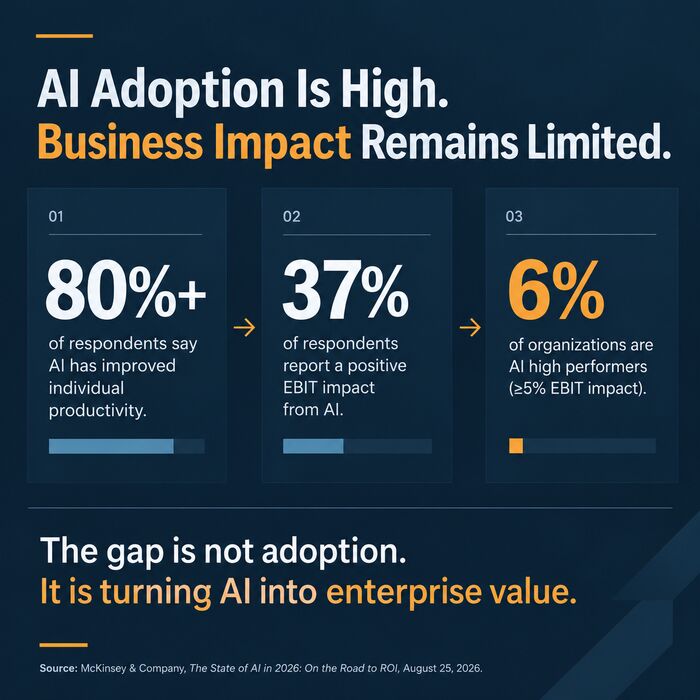
According to the report, 80% of respondents say AI has improved individual productivity, yet only 37% report a positive EBIT impact.
One possible explanation is that organizations are still struggling to measure AI’s financial contribution.
But I wonder if the bigger issue lies elsewhere.
Today, many companies have successfully deployed AI at the individual level:
- Writing content faster
- Developing code faster
- Producing analyses faster
- Completing knowledge work more efficiently
Yet in many organizations, these gains still happen within largely unchanged workflows, organizational structures, and decision-making processes.
Employees may be working faster.
The business may not be operating differently.
That’s an important distinction.
The companies creating the most value from AI do not appear to be simply giving employees better tools. According to McKinsey, they are redesigning workflows, scaling agentic capabilities, and fundamentally changing how work gets done.
In other words, there is a significant difference between:
Using AI to improve tasks.
and
Using AI to transform processes.
The first improves productivity.
The second has the potential to improve EBIT.
From a CFO perspective, this is also where the measurement needs to change: from hours saved and adoption rates to economic outcomes — cost-to-serve, capacity released, revenue uplift, working capital, and ultimately return on invested capital.
This may help explain why AI adoption is accelerating across enterprises while meaningful financial impact remains concentrated among a much smaller group of organizations.
Perhaps the challenge is no longer AI adoption.
Perhaps the challenge is moving from AI-assisted work to AI-enabled operating models.
What do you think?
Are organizations failing to measure AI’s value, or are most still using AI as a productivity tool rather than a true business transformation lever?
Source: McKinsey & Company, “The State of AI in 2026: On the Road to ROI,” August 25, 2026.