The best planning processes are neither purely top-down nor purely bottom-up.
Top-down planning sets the ambition: growth, profitability, and cash generation. Bottom-up planning tests whether that ambition is commercially credible and operationally executable.
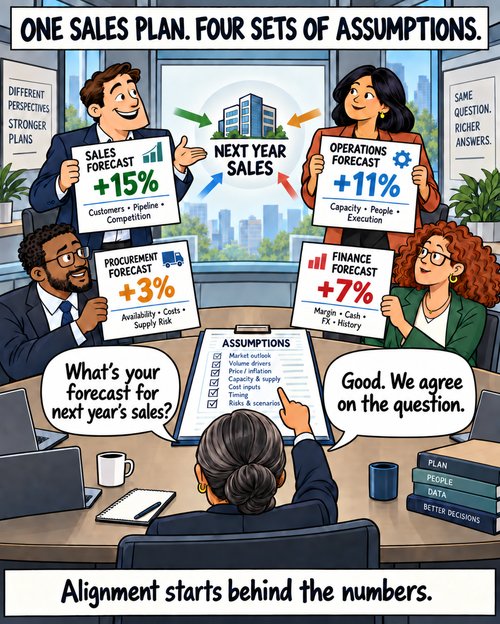
In one of my previous roles, annual sales forecasts were developed with input from Sales, Operations, Procurement, and Finance. Significant differences often emerged — both at total business and detail level.
What I learned from these planning cycles was that the biggest forecasting gaps were rarely just numerical. They reflected differences in assumptions, initiatives, and access to information.
Each function viewed the future through a different lens:
- Sales: Customer insights and competitive dynamics
- Procurement: Supplier capacity, sourcing risks, and input costs
- Operations: Capacity, processes, and supply chain feasibility
- Finance: Margins, working capital, cash, and FX exposure
The real question was never, “Which number can we agree on?”
It was:
What would need to be true for the plan to succeed?
Which assumptions explain the gaps?
Which risks could change the outlook?
What actions should be triggered if conditions shift?
A strong planning process delivers:
- One evidence-based base case
- Upside and downside scenarios
- Clear ownership of assumptions and leading indicators
- Pre-agreed decision triggers
- An integrated commercial, operational, and financial plan
Once agreed, the forecast must translate into coordinated decisions across pricing, inventory, procurement, hiring, investment, and cash allocation.
An overly optimistic forecast can create excess inventory, unnecessary capacity, and cash pressure.
An overly cautious one can constrain investment and leave profitable growth opportunities uncaptured.
The goal is not to predict the future perfectly. It is to make better decisions before the future becomes clear.
How does your organization resolve forecast disagreements: by negotiating a number or testing the assumptions behind it?