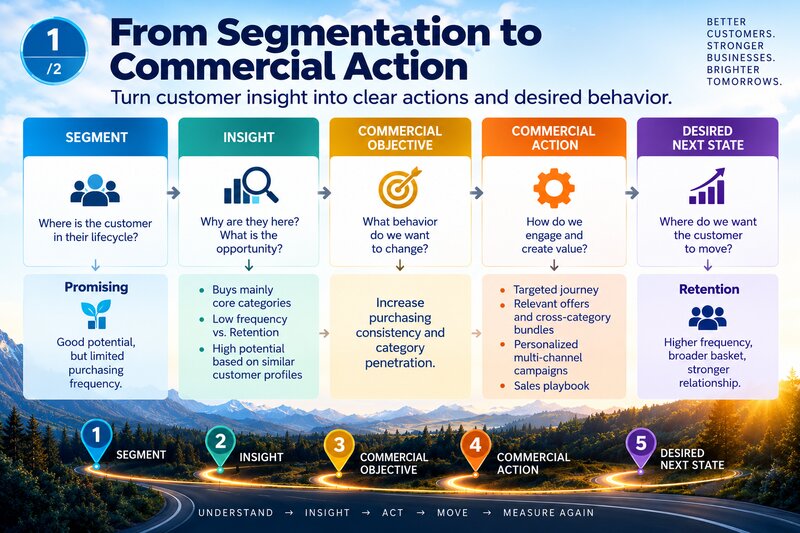
The purpose of customer segmentation is not to put customers into boxes.
It is to make customer complexity manageable — and ultimately actionable.
When you have a large and diverse customer base, managing every customer individually does not scale. But treating everyone the same does not work either.
That was the starting point of our journey with RFM segmentation.
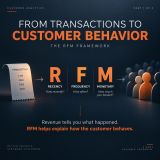
The idea behind RFM is simple: instead of looking only at how much revenue a customer generates, look at how that customer behaves.
- R — Recency: How recently did the customer buy?
- F — Frequency: How frequently did the customer buy?
- M — Monetary: What was the customer’s average basket value?
Why do these three dimensions matter?
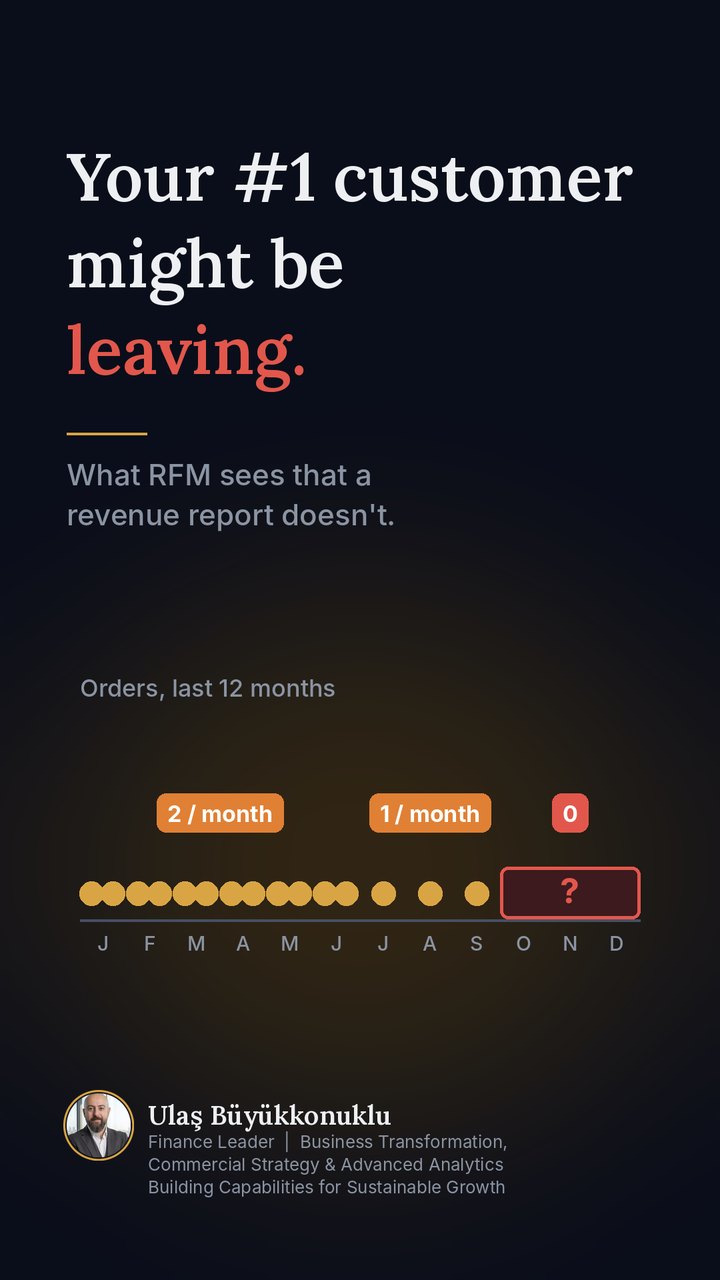
Because two customers generating similar revenue can have completely different purchasing behaviors.
Revenue tells you what happened.
RFM helps explain how the customer behaves.
The next step is turning those behaviors into something that can be managed at scale.
Each R, F and M dimension can be scored from 1 to 5, and the three scores are combined into an RFM profile.
For example:
- 111: recent purchase, high frequency, strong average basket
- 135: recent purchase, medium frequency, lower average basket
- 511: long time since the last purchase, but historically frequent with a strong average basket
With five possible scores across three dimensions:
5 × 5 × 5 = 125 possible behavioral profiles.
And this is where RFM starts becoming more interesting than a simple customer ranking.
The 111 segment represents customers with strong behavior across all three dimensions — recent, frequent and high-value purchasing.
The 511 segment tells a very different story: customers who were historically frequent with strong basket values, but have not purchased recently.
That is a very different commercial signal from simply labeling the customer as “low value.”
For me, this is one of the real strengths of behavioral segmentation.
It moves the conversation beyond:
“How much does this customer spend?”
toward:
“What kind of purchasing relationship do we currently have with this customer?”
That creates a much stronger foundation for customer strategy, CRM and commercial decision-making.
But RFM is still only a framework.
It does not automatically tell you what “recent,” “frequent,” or “high value” should mean for your specific customers and business model.
And that is where the next part of the story begins:
How do you move from a standard RFM framework to a segmentation model designed around the realities of your own business?
Continued in Part 2: Customizing RFM for Your Business.