From static scores to actionable segments
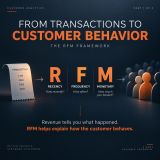
In the first post of this series, I explored how RFM segmentation turns customer transactions into behavioral profiles through Recency, Frequency and Monetary dimensions.
But building the profiles is only the starting point.
The next challenge is making the model reflect how your customers actually behave.
One of the most important choices is how the R, F and M scoring thresholds are defined.
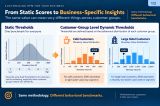
Using the same static thresholds for every customer can be misleading — especially when different customer groups have very different purchasing patterns.
Think about a café and a large hotel.
An average basket of €500 might represent strong purchasing behavior for the café, while the same €500 could be relatively low for the hotel.
Same value. Different meaning.
Instead of applying one fixed threshold across the entire customer base, the behavioral distribution of each RFM dimension should be considered at customer-group level.
The histogram shows where customers actually sit within their own peer group, allowing dynamic thresholds to be defined according to the behavior of each customer group.
Same methodology. Different behavioral benchmarks.
This creates a much more meaningful set of behavioral micro-segments.
But analytical precision creates another challenge.
Micro-segments provide analytical depth, but that level of granularity is not practical for commercial execution.
The micro-segments can therefore be retained as the analytical layer, while being grouped into a smaller number of actionable customer segments, such as:
Activation · Promising · Retention · VIP · At Risk · Churn · Lost · Reactivation
This creates two complementary layers:
- Micro-segments help us understand customer behavior.
- Actionable segments help us manage it.
The objective is not to sacrifice analytical detail for simplicity.
It is to preserve the analytical granularity while making segmentation commercially actionable.
Keep the granularity. Make it actionable.
And that leads to the next question:
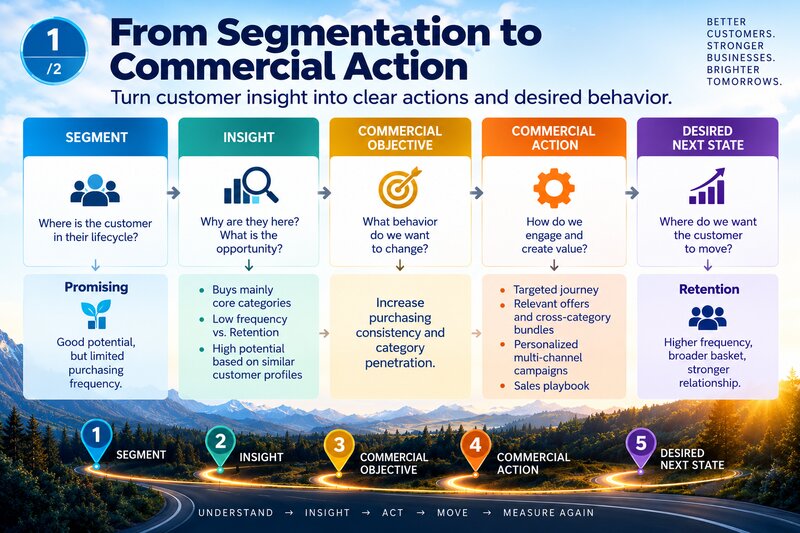
What should we actually do differently for each segment?
Continued in Part 3: From Segmentation to Commercial Action.