From insight to action — and measuring what actually works
In the second post of this series, I explored how behavioral micro-segments can be transformed into actionable customer segments without losing the analytical granularity behind them.
But creating actionable segments is only the next step.
A segment alone does not create value.
Knowing that a customer is Promising, VIP, At Risk or Churn only becomes useful when it changes what the organization does next.
That is where segmentation moves from classification to activation.
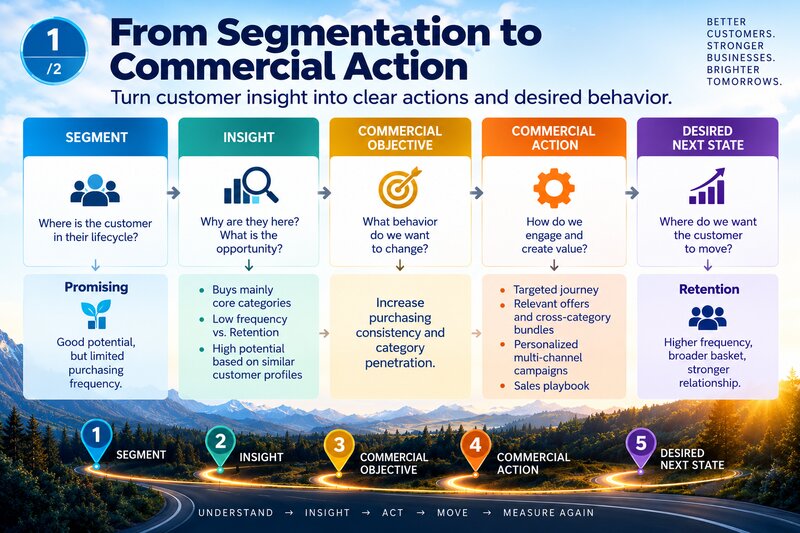
Before deciding on the action, however, there is one critical step: turning the segment into insight.
A segment tells us where the customer is. The analysis behind it should help us understand why the customer is there and what opportunity exists.
For example:
- What are they buying — and not buying?
- How does their behavior differ from more developed customers?
- Where is the unrealized potential?
- What behavioral change would move the relationship forward?
These insights define the commercial objective.
Only then should the commercial response be designed:
Customer Journey · Value Proposition · Campaign & Communication · Sales Playbook
All connected to a clear desired customer behavior and next state.
Now the segment is no longer just a label. It becomes a commercial decision framework.
But there is still one important question:
Did the action actually change customer behavior?
This is where Segment Transition closes the loop.
Instead of looking only at how many customers are currently in each segment, we can track how customers move between segments over time.
This allows us to understand which actions are working, which customers are moving in the desired direction, where behavior is deteriorating, and which interventions actually change customer behavior.
A snapshot tells you where your customers are.
Segment Transition tells you where they are going.
And that completes the cycle:
Measure → Understand → Act → Move → Measure Again
Segmentation is no longer simply a way to classify customers. It becomes a continuous customer management system connecting analytics, commercial execution and measurable customer behavior.
Segmentation identifies the opportunity.
Insight explains it.
Commercial action captures it.
Segment Transition tells us whether it worked.