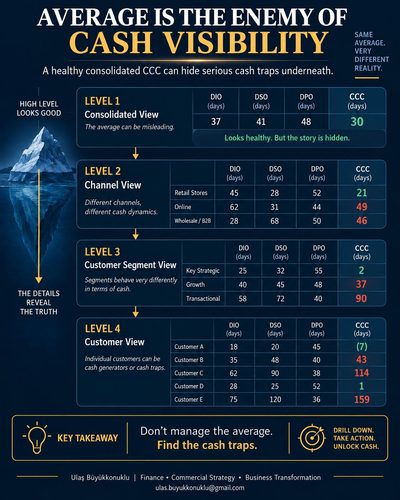
A healthy consolidated "Cash Conversion Cycle" can hide serious cash traps underneath.
At company level — and sometimes even at channel level — the numbers may look perfectly healthy.
But averages have a weakness: they hide extremes.
One channel may generate cash while another consumes it.
Within the same channel, one customer segment may operate with favorable payment dynamics, while another requires significantly more working capital to generate the same level of revenue.
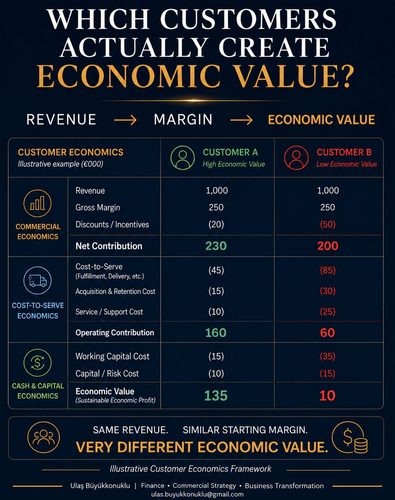
And when we go even deeper, some customers that look attractive from a revenue or margin perspective may become value drains once their full cash economics are considered.
This is why looking only at consolidated CCC is not enough.
The real insight starts to emerge when we break the economics down:
Company → Channel → Customer Segment → Customer
The deeper we go into the averages, the closer we get to the decisions that actually create or consume cash.
And the management conversation changes.
Instead of asking:
“Is our CCC improving?”
We can ask:
- “Where is our cash actually trapped?”
- “Which parts of our growth are consuming disproportionate working capital?”
- “Where are we creating value — and where are we quietly draining it?”
Averages are useful for reporting.
Granularity is what turns cash visibility into action.
Have you ever found a customer that looked profitable on paper but was quietly draining cash?