The rent hasn't changed.
The lease term hasn't changed.
The store hasn't become more profitable.
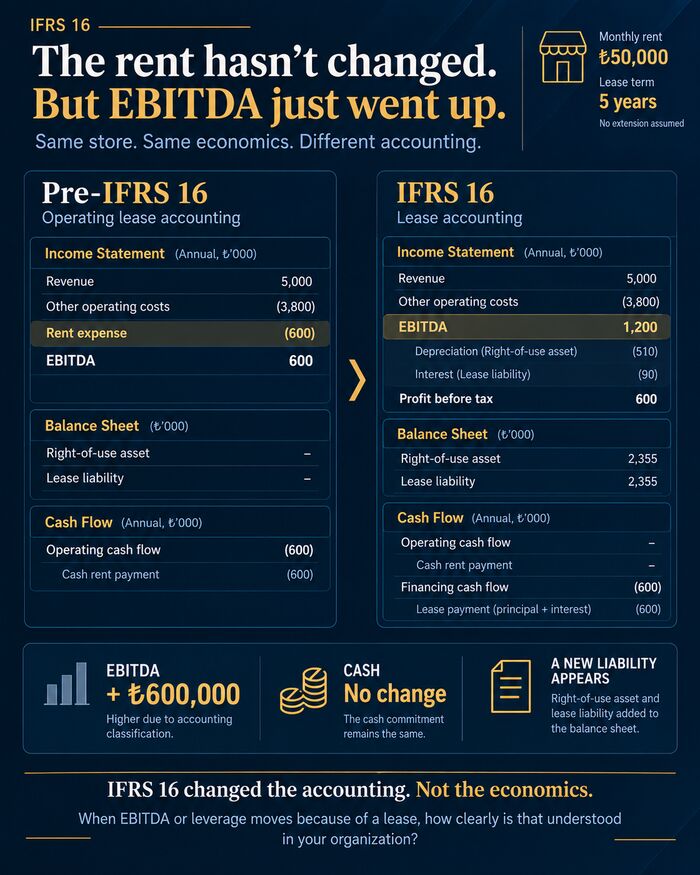
Yet EBITDA just went up — and a new liability appeared on the balance sheet.
What changed? The accounting.
IFRS 16 fundamentally changed how leases appear in the financial statements.
Take a simple example:
₺50,000 monthly rent.
5-year lease.
No extension assumed.
Under the old operating lease treatment, ₺600,000 of annual rent would sit in operating expenses and reduce EBITDA.
Under IFRS 16, that rent expense disappears from EBITDA.
Instead, the lease creates:
- a Right-of-Use Asset
- a Lease Liability
- Depreciation on the asset
- Interest on the liability
The cash commitment hasn't disappeared.
But EBITDA increases by ₺600,000.
And that's where accounting starts becoming a management question.
Because if EBITDA improves without any change in the underlying economics, we need to understand what the KPI is actually telling us.
For a CFO, I think the more interesting questions are:
- Are we separating IFRS 16-driven EBITDA improvement from genuine operating performance?
- When evaluating lease vs. buy, are we looking beyond headline rent to capital employed, leverage and cash commitments?
- When Net Debt / EBITDA moves because of leases, does everyone around the management table understand what is driving it?
- And when determining the lease term, is the “reasonably certain” extension judgment genuinely reflecting the economics of the decision?
These are not just accounting questions.
They affect performance interpretation, capital allocation, leverage and commercial decisions.
And sometimes the easiest way to understand those interactions is simply to change the assumptions and watch what happens.
So I built an interactive IFRS 16 simulator.
Change the:
Rent → Lease Term → Discount Rate → Escalation
and see how they move the P&L, Balance Sheet, Cash Flow and leverage metrics together.
One number may improve while the economics remain exactly the same.
When EBITDA or leverage moves because of a lease, how clearly is that understood in your organization?