The customer has paid. The invoice has been issued.
How much revenue belongs in this month’s results?
That question matters when sales targets, margin forecasts and management decisions depend on the answer.
An advance payment improves liquidity while obligations to the customer may still be outstanding. A single invoice can cover goods and services transferred in different periods. A volume rebate can change the amount the business expects to earn.
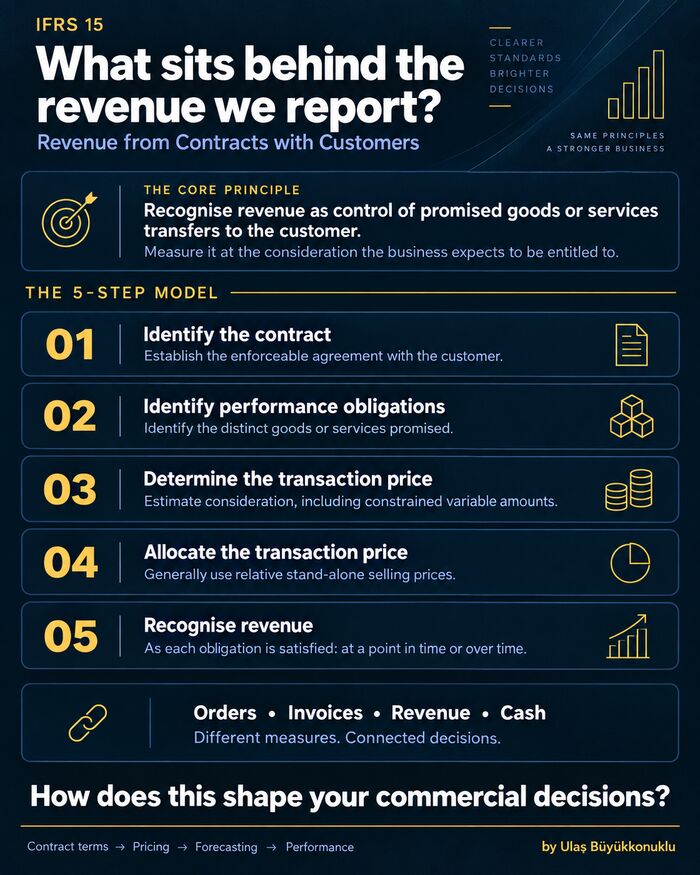
IFRS 15 — Revenue from Contracts with Customers — provides a framework for deciding both when to recognise revenue and how much to recognise.
Its core principle: revenue reflects the transfer of promised goods or services to the customer, measured at the consideration the business expects to be entitled to.
Five steps connect the commercial agreement to the reported number:
1. Identify the contract.
Establish the enforceable rights and obligations.
2. Identify the performance obligations.
Determine the distinct goods or services promised.
3. Determine the transaction price.
Assess the expected consideration, including variable amounts such as rebates, subject to limits on uncertainty.
4. Allocate the transaction price.
Generally use the relative stand-alone selling prices of the performance obligations.
5. Recognise revenue as each obligation is satisfied.
Control may transfer at a point in time or over time.
For me, the management question is how early this understanding enters the commercial conversation.
When we agree a rebate, is its expected impact already in the forecast?
When we sell a bundle, do we understand which commitments remain outstanding?
When we review monthly performance, can everyone explain the difference between orders booked, invoices issued, revenue recognised and cash collected?
Each measure serves a purpose. The risk arises when teams use them interchangeably.
For a CFO, this means bringing the revenue implications of commercial terms into pricing, forecasting and target setting before the deal is signed.
Which measure drives your sales targets: orders, invoicing, recognised revenue or cash — and how do you reconcile it with reported performance?