My focus here is on a practical question beyond the technical details of IAS 2: how much do we use the insight behind these calculations to inform commercial decisions and challenge the way we buy, price and manage inventory?
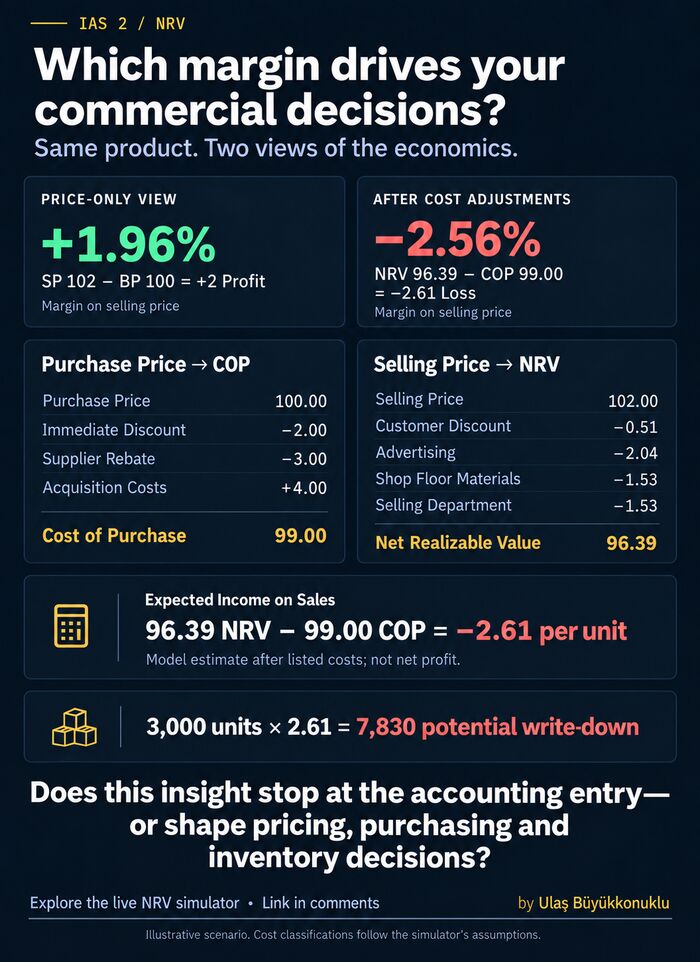
The same product can show a +1.96% price-only margin and a −2.56% result after the adjustments in this example.
The difference is in what the calculation includes.
Purchase price: 100.
Selling price: 102.
An apparent profit of 2 per unit.
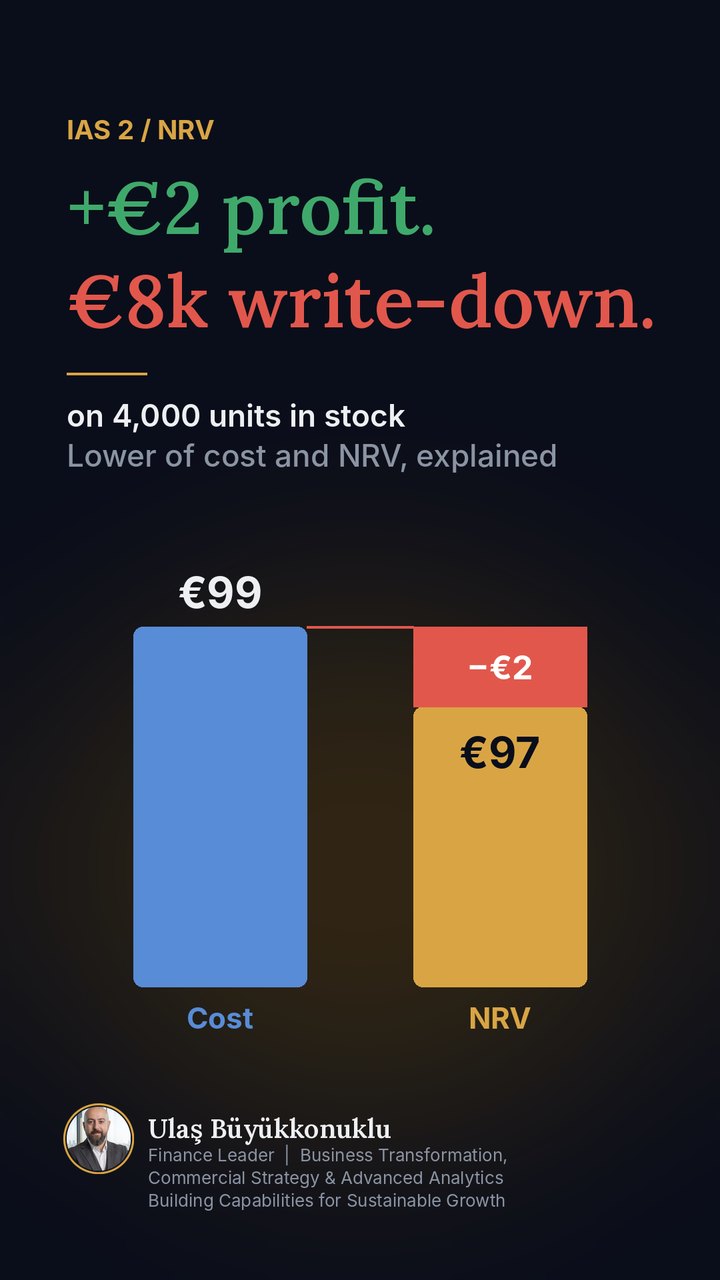
After purchase discounts, supplier rebates and acquisition costs, Cost of Purchase is 99.
After the customer discount and estimated costs necessary to sell, Net Realizable Value is 96.39.
That leaves a shortfall of 2.61 per unit — and a potential inventory write-down of 7,830 across 3,000 units.
IAS 2 provides the inventory valuation framework. My question is how much of the insight behind that valuation reaches the commercial decision.
Does the conversation end with an accounting entry? Or does it reach the people deciding what to buy, how to price it, and how long to hold it?
- Are product-level risks visible beneath category averages?
- When expected selling prices fall, do we revisit purchasing terms and reorder quantities?
- Does a recurring write-down lead us to challenge the assortment or the demand assumptions behind it?
- Would we make the same decisions with this information visible earlier?
Cost of Purchase and NRV do not, by themselves, provide a complete profitability measure. Combined with current replacement costs, demand, sell-through and holding costs, however, they can inform commercial decisions.
For a CFO, the opportunity is to make the assumptions behind inventory valuation visible early enough — and shared widely enough — to influence pricing, purchasing and inventory decisions.
I built an interactive simulator showing the calculations side by side, with adjustable inputs, to make that discussion more tangible.
In your organization, what is one commercial decision your IAS 2 / NRV analysis has changed?