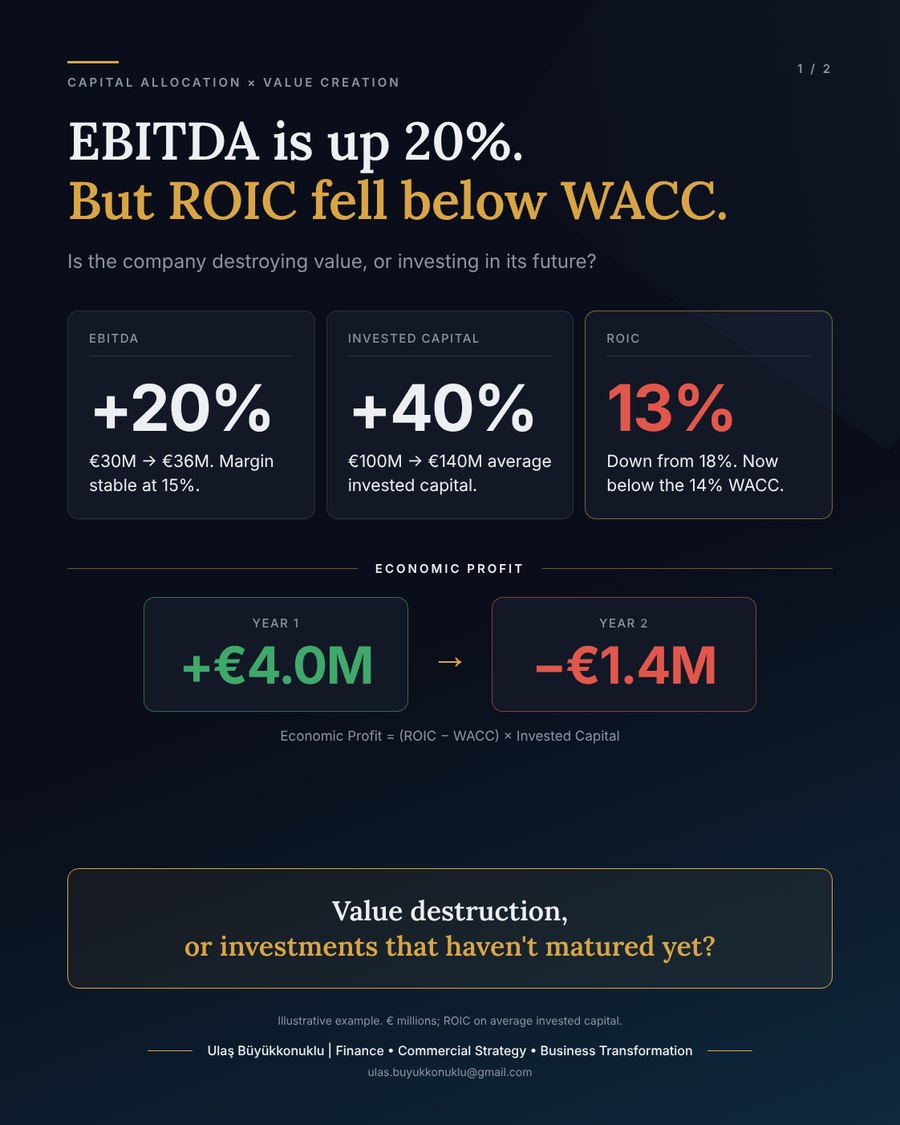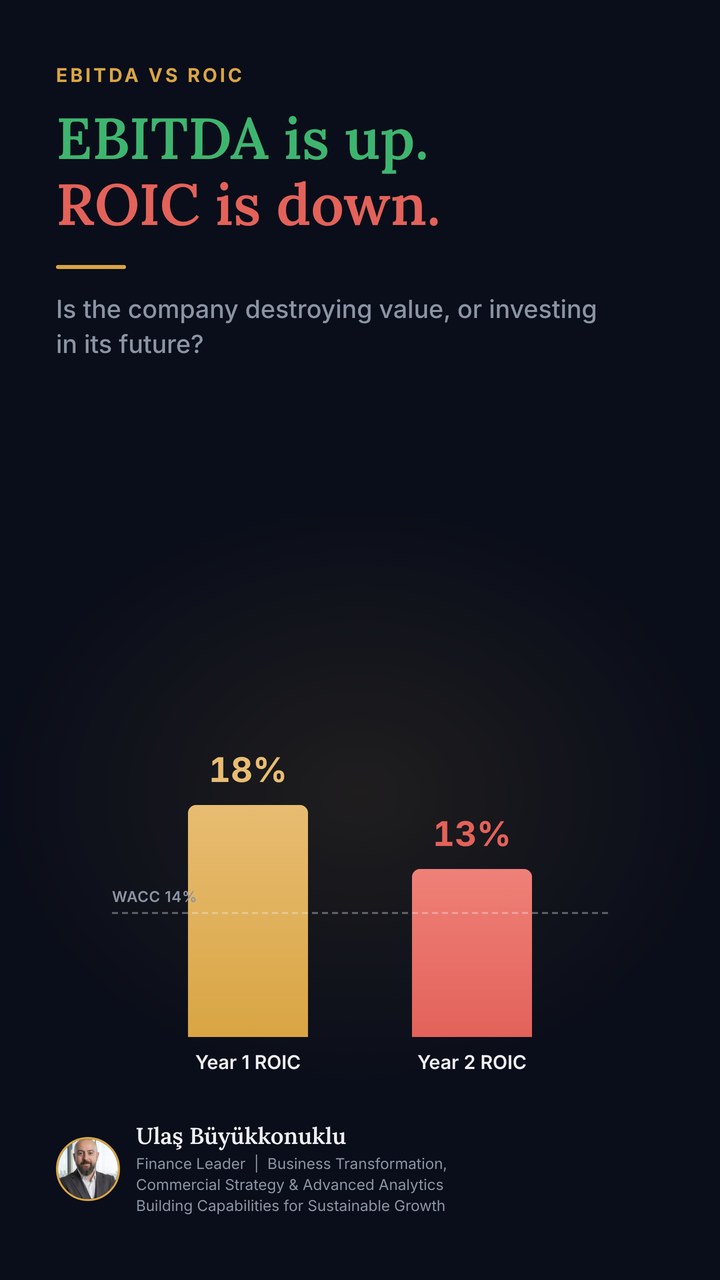
EBITDA is up 20%. ROIC is down 5 percentage points.
Is the company destroying value, or investing in its future?
Consider a company reporting the following year-on-year performance:
Revenue: €200M → €240M (+20%)
EBITDA: €30M → €36M (+20%)
NOPAT: €18.0M → €18.2M (+1%)
Average Invested Capital: €100M → €140M (+40%)
EBITDA margin remains stable at 15%, but ROIC declines from 18% to 13%, falling below the company's assumed 14% WACC.
Economic Profit moves from +€4M to −€1.4M.
At first glance, this looks like deteriorating capital efficiency.
But what if the increase in invested capital reflects new investments that have not yet reached their expected operating performance?
New stores, production facilities, or capacity expansion require capital upfront. Depreciation is already increasing, while the full earnings contribution takes time to materialize.
As a result, consolidated ROIC can decline even when the underlying investment decisions are economically sound.
So, how should we read these numbers?
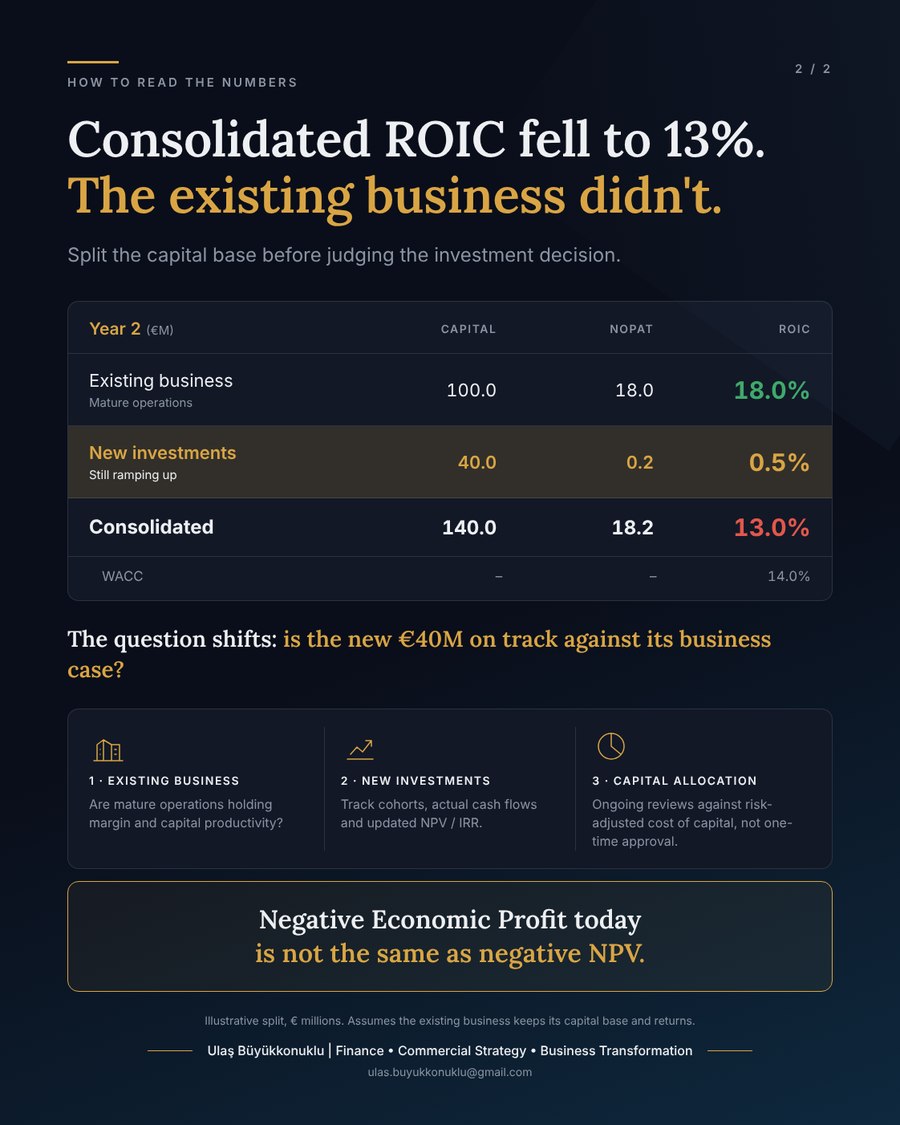
From a CFO perspective, I would separate the analysis into three areas:
1. Existing business
Are mature operations maintaining their profitability and capital productivity?
Separating existing operations from new investments helps identify whether the decline comes from operational performance or the investment cycle.
2. New investments
Are investments progressing as expected against their original business cases?
Tracking investment cohorts, actual cash flows, and updated NPV/IRR expectations provides a more meaningful assessment than looking at short-term ROIC alone.
3. Capital allocation
Are we consistently allocating capital to opportunities that can generate returns above their risk-adjusted cost of capital?
This requires ongoing investment reviews, not just approval of the initial business case.
A declining ROIC deserves attention, but not necessarily a change in investment strategy.
The important distinction is whether we are seeing a temporary effect of investments that are still maturing or a structural decline in capital productivity.
Negative Economic Profit today does not necessarily mean negative NPV over the investment lifecycle.
Growth matters. But how we allocate capital determines the value of that growth.
How do you separate maturing investments from a structural decline in returns?