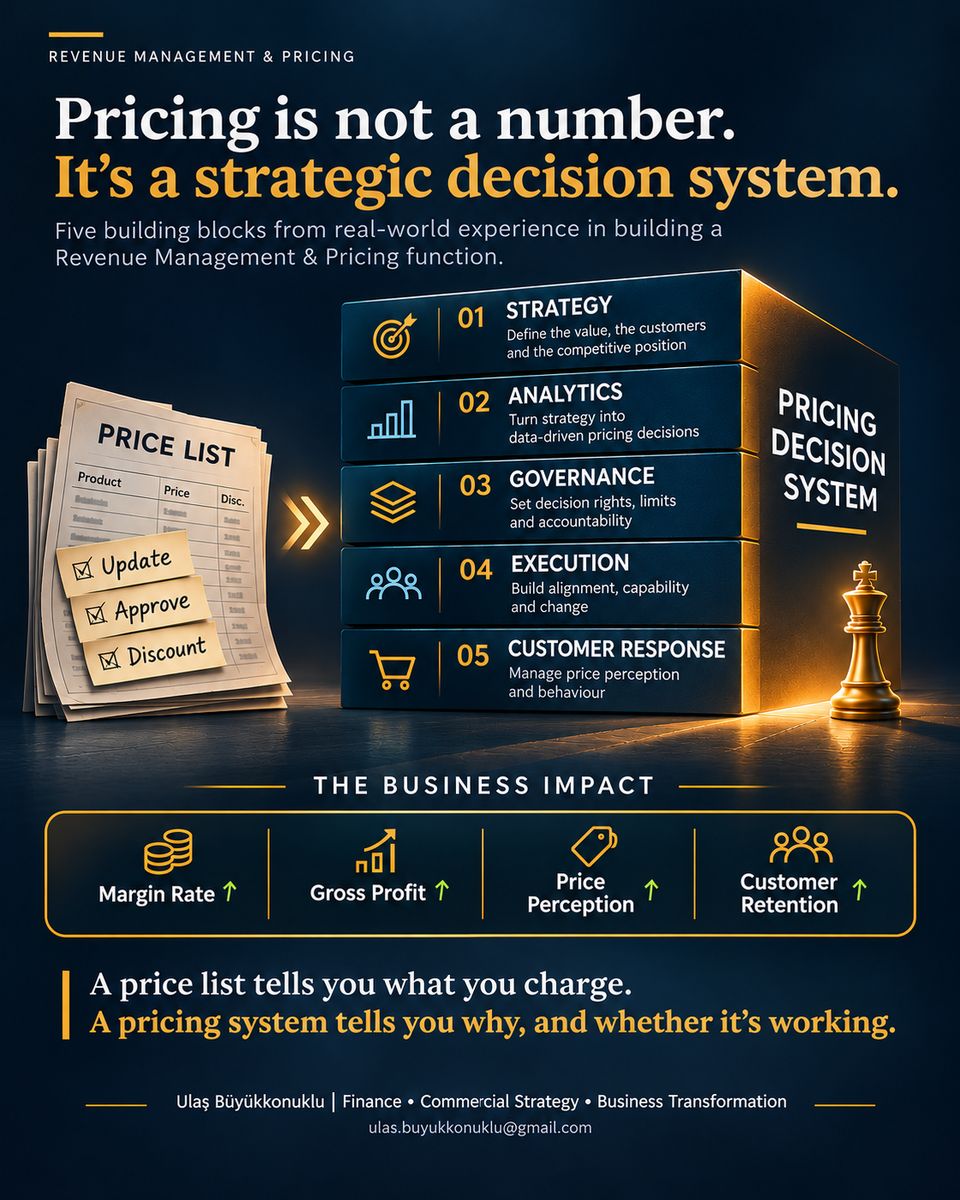
Pricing is not a number. It's a strategic decision system. ♟️
In many companies, pricing still means a price list.
Someone updates it, someone approves it, and someone else gives the discount.
When margin moves, nobody can really explain why.
When I set up the Revenue Management & Pricing function at METRO Türkiye, the hardest part was not the algorithm or the tool.
A tool is only an engine. Without the right pricing strategy, governance and change management, it just automates yesterday's mistakes.
Most of the work was building a system around the price and getting the whole organization behind it.
Five lessons I took from it:
1 — Pricing strategy starts with value proposition
The first question is not "what should the price be?" It is "what value do we offer, to which customers, and where do we want to stand against competitors?"
2 — Algorithms follow strategy
Our first models were not directly linked to our strategic targets and revenue scenarios. So we set those targets as the frame the model had to work within. After each optimization cycle we went back and improved the segmentation, the variables and the data behind price elasticity. Over time, the algorithm got more accurate.
3 — Governance defines who owns the price
Decision rights, discount limits and escalation rules mattered as much as the price itself. We designed the pricing organization and built the team and its capabilities. Then we made it clear who sets the price, who can approve an exception, and who answers for the result. Without that, the price gets decided in the last customer conversation.
4 — Alignment makes it happen
Change management was as important as the model itself. Sales, Category Management and Finance had to believe in the same logic. If people inside the company don't believe in a price, it won't survive the first tough customer conversation.
5 — The customer decides whether it works
How we communicated a price shaped how customers saw it. Over time, price perception and customer behaviour became as important a signal as margin.
For me, a successful pricing strategy and tool implementation is never measured by margin alone. Margin rate and gross profit need to grow together, while price perception improves and customers stay. That is how we measured it, and that is where we saw the improvement.
A price list tells you what you charge.
A pricing system tells you why, and whether it's working.
Which of these five is the weakest link in your organization?